
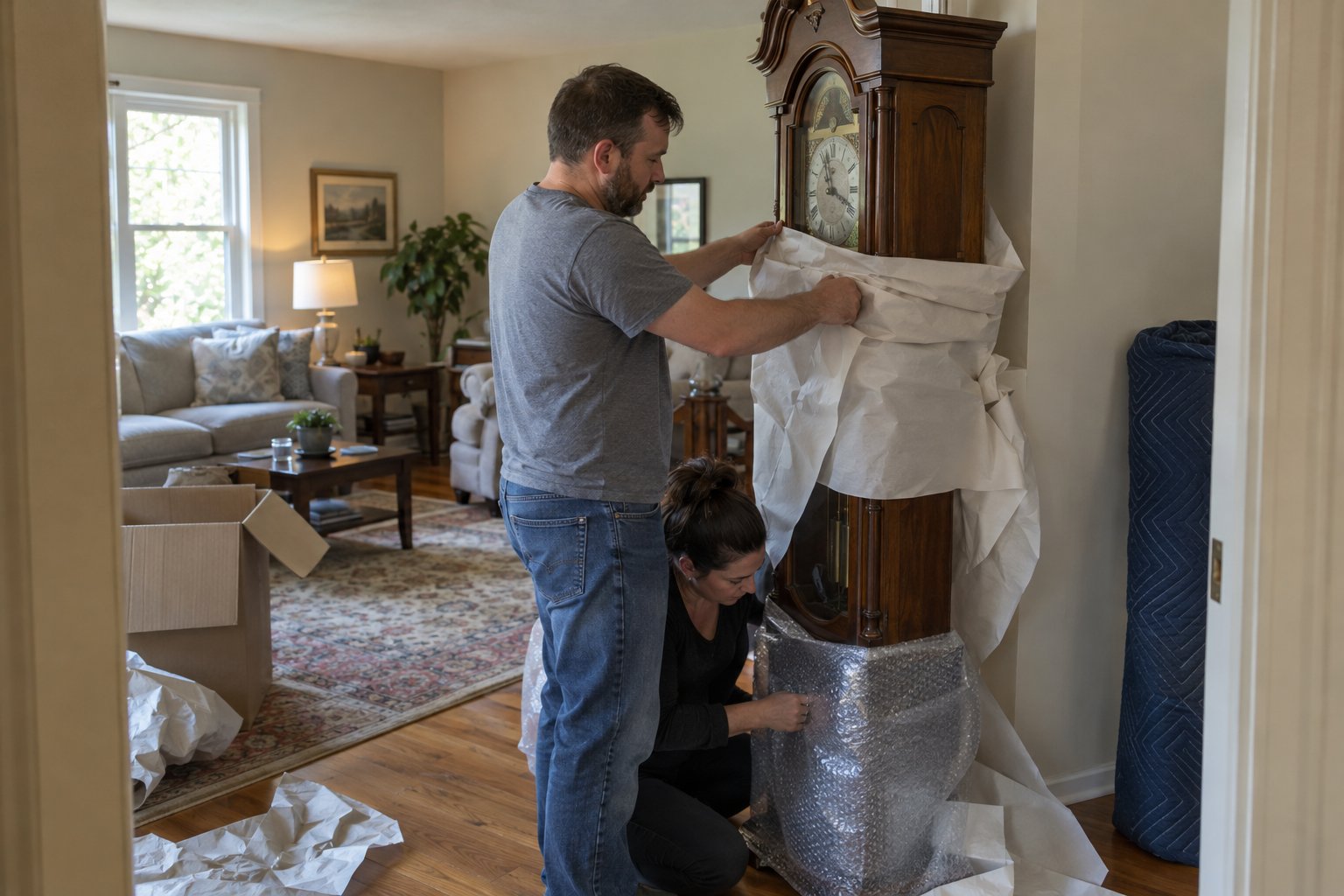
Grandfather Clock Moving Checklist: A Step-by-Step Timeline
Written by:
Full Time Movers Team
Published:
November 2, 2026
Use this checklist to learn how to move a grandfather clock safely, from locking the pendulum to reassembly, with a timeline you can follow before moving day.
A grandfather clock moves safely when its weights, pendulum, and chime mechanism are removed and packed separately from the cabinet, and the empty cabinet itself is wrapped, braced, and kept upright through transport. Treat it less like a single piece of furniture and more like three or four fragile components that happen to share one wooden case. Skip a step and the clock can arrive with a cracked finial, a bent chime rod, or a movement that never keeps time the same way again.
This checklist lays out what to do in the weeks, days, and hours before the move, what actually happens on moving day, and why each group of tasks matters instead of just listing them. Work through it in order and you'll reduce the chance of damage considerably.
Why Does a Grandfather Clock Need Special Handling to Move?
A grandfather clock is heavy, top-heavy, and built around moving internal parts that are only stable when the clock is standing still and level. The weights and pendulum that keep it running are exactly what make it dangerous to transport if they're left in place.
Most cabinets stand well over six feet tall on a narrow base, so the center of gravity sits high. Inside, brass or lead weights hang on cables or chains, and a pendulum swings on a thin suspension spring. If the clock is tipped, rocked, or jostled with those parts still hanging, the weights can swing hard enough to damage the movement, snap the suspension spring, or scratch the interior of the case. That's why every reputable approach to moving one starts with taking the moving parts out first, not with lifting the whole cabinet as-is.
Two to Three Weeks Out: Research and Preparation
This is the stage for learning your specific clock and gathering supplies, not for touching the mechanism yet. Rushing this part is where most mistakes start.
- Find the manufacturer's manual or markings inside the case. Movement types vary, and some clocks have a documented locking procedure for the pendulum and chime hammers that others don't.
- Photograph the inside of the clock before you touch anything. A photo of the weights, pendulum, and any chime labels makes reassembly far easier later.
- Gather supplies: moving blankets or furniture pads, packing paper, small labeled boxes or bags for weights and the pendulum, painter's tape, and a dolly rated for the clock's weight.
- Decide how much of this you want to do yourself. An antique or an unusually tall case clock is a reasonable point to think carefully about the carrying and loading, even if you handle the mechanism yourself.
How Do You Prepare the Clock Itself Before Moving Day?
Preparing the clock means stopping it, removing the weights and pendulum, and securing anything left inside so nothing can shift during transport. This part takes patience more than tools.
- Stop the clock and let the chime finish its cycle rather than interrupting it mid-chime, which can leave the chime train out of sync.
- Remove the weights one at a time, in order, and label them. Weights are usually marked left, center, and right (or by weight), and swapping them later throws off the clock's timing and chime.
- Remove the pendulum carefully by its top, not the disc. The suspension spring it hangs from is thin and bends or snaps easily.
- Wrap the pendulum and each weight individually in packing paper and place them in a small, clearly labeled box. Never leave them loose in the bottom of the cabinet.
- Lock or wedge the chime hammers and any moving rods if the manufacturer's instructions call for it, so they can't rattle against the chime rods in transit.
- Remove or secure the hood and any glass panels, taping glass doors shut or removing them if they're loose-fitting, and padding the finial on top separately since it's often just friction-fit.
Packing the Cabinet for Transport
Once the inside is empty and padded, the cabinet itself needs wrapping and bracing so it travels upright without shifting against other items. A grandfather clock should never be laid on its back or side for a move.
- Wrap the full cabinet in furniture pads, securing them with tape or stretch wrap rather than tape directly on the wood finish.
- Pad the corners and base separately since these take the most impact if the clock shifts.
- Keep the clock upright in the truck, braced against a wall or secured with straps so it can't tip or lean against other furniture.
- Load it last and unload it first when possible, so it isn't buried under boxes and other items for the whole trip.
Moving Day: What to Do When the Truck Arrives
On moving day itself, the goal is simply to carry the padded, empty cabinet to the truck without tipping it, then keep it upright and braced for the ride. If you've already removed the weights and pendulum, this part is mostly about careful lifting.
- Confirm the case is empty and everything loose has been removed or taped down before anyone lifts it.
- Use a four-wheel dolly and at least two people for a cabinet of this height, with one person steadying it at all times.
- Tilt the clock only as far as needed to get it onto the dolly, and keep it as close to vertical as the doorway allows.
- Walk it slowly through doorways and turns. As a rule of thumb, plan for this to take roughly twice as long as moving a similarly sized dresser, simply because of the extra care at every turn.
- Once it's placed in its new spot, let it sit for a few hours before reassembling the pendulum and weights, so the case can settle and you aren't rushing the mechanical work.
Reassembly and Getting It Running Again
Reassembly reverses the packing steps: weights go back in their original marked positions, the pendulum goes back on its suspension spring, and the clock needs to be leveled before it will keep time. A clock that was never leveled at the new address is the single most common reason owners think something broke in transit.
- Check that the new spot is on a level, stable floor. Use a small level against the case and adjust the feet or add shims if needed.
- Rehang the pendulum first, then reinsert the weights in their original marked positions.
- Start the pendulum swinging gently and let the clock run for a day before expecting the chime and strike to settle into sync.
- If the clock runs fast, slow, or the chime strikes at the wrong time, small adjustments are normal in the first few days and usually resolve with minor leveling rather than a mechanical problem.
If a piece in your home is large, delicate, or awkward to maneuver on your own, it's worth reviewing our Large / Specialty Items page to see how we approach items like these. For the rest of the house, our Local Moving crews handle the loading, carrying, and placement that go around a move like this. Protecting the floors and doorways a clock travels through matters too, and we've covered that in more detail in our guide to protecting furniture and floors when moving.
If you're planning this move from Stamford, CT or Yonkers, NY, give yourself the full two to three weeks above, since both the prep and the reassembly take longer than people expect on a tight timeline.
Before you begin, it's worth reviewing general safe-lifting guidance like the kind OSHA publishes on ergonomics, since a clock this heavy and awkward is exactly the sort of lift where technique matters more than strength.
Planning your move? Request a quote from Full Time Movers.
Frequently Asked Questions
Do I need to remove the weights before moving a grandfather clock a short distance?
Yes. Even a move across the room should start with removing the weights and pendulum, since any tipping or jostling while they're in place can damage the movement or snap the suspension spring.
How long should I wait before starting a grandfather clock after a move?
Give the case a few hours to settle in its new spot and get it level before rehanging the pendulum and weights. Expect the chime and strike to take about a day to fall into sync once it's running again.
Can a grandfather clock be laid on its back for transport?
No. It should stay upright throughout the move, braced so it can't tip, rather than laid down like a dresser or bookshelf.
What should I tell movers about a grandfather clock before moving day?
Let them know its height, approximate weight, and that the weights and pendulum will already be removed and packed separately, so they can plan the doorway route and dolly setup in advance.
Why does my grandfather clock chime at the wrong time after moving?
This is usually a leveling issue rather than damage. Check that the case is level on the floor and give the mechanism a day of running time before making further adjustments.




Ready for Your Next Move?
Moving within New Jersey or heading to another state? Full Time Movers handles residential, commercial, and long-distance moves from Jersey City and surrounding areas. Get in touch for a free moving quote.